Arlington runs from Downtown and the UT Arlington campus north along TX-360 to the entertainment district around AT&T Stadium, Globe Life Field and Six Flags Over Texas, with residential blocks spreading through North, South and East Arlington along the I-20 and I-30 corridors. The city's roughly 57,000 residents live in a housing mix that ranges from post-war and mid-century ranch homes near Downtown to newer two-story subdivisions toward Mansfield and Grand Prairie. That spread matters for roofing: a 1950s house with a low-slope porch addition and a 2015 build with a steep architectural-shingle roof fail in completely different ways, and both need a roofer who has actually worked in Tarrant County.
Arlington's humid subtropical climate is hard on roofs in a specific way. Summers push surface temperatures on dark shingles well past ambient air, baking out the volatiles that keep asphalt flexible, so granules wash off and the mat dries out years before the roof looks obviously bad. Then spring and early summer storms roll up the I-20 corridor with hail and straight-line wind that crack shingle tabs, lift ridge caps and drive water past pipe boots and step flashing. Mild winters still bring the occasional hard freeze, which shrinks and opens sealant joints around vents and chimney counterflashing. The result is a lot of roofs that leak at penetrations long before the field shingles are worn out.
Texas Roof Specialists is a statewide roofing service-connection brand — our business address is in Houston, and we connect Arlington homeowners with local roofing professionals rather than pretending to staff a yard on Cooper Street. Work is scoped with an upfront quote, and the roofers we connect you with include RCAT-certified professionals. Whether you need a single leak traced at a valley, a hail-damage inspection with photo documentation, or a full tear-off and replacement, the goal is the same: a written scope you can read, materials you can identify, and workmanship you can inspect before final payment.
Roofing Services Commonly Needed in Arlington
Most Arlington calls fall into a handful of categories, and the right answer depends on what the roof is actually doing rather than what it looks like from the curb.
- Roof Repair — torn or missing shingles, failed pipe boots, cracked vent seals, popped nails, damaged ridge caps and open flashing at chimneys, valleys and sidewalls.
- Roof Replacement — full tear-off and re-roof when the shingle field is worn, when hail has compromised the mat, or when a second layer has to come off before a new one goes on.
- Roof Installation — new-construction and addition roofing, including low-slope sections over garages, porches and rear extensions.
- Roof Leak Detection and Repair — tracing water to its actual entry point instead of patching the ceiling stain, with attention to valleys, dormers, skylights and step flashing.
- Roof Inspections — pre-purchase, post-storm and annual inspections with photos of the deck, underlayment, flashing and penetrations.
- Roof Maintenance — clearing debris from valleys and behind chimneys, resealing exposed fasteners and sealant joints, and replacing worn boots before they leak.
- Storm and Hail Damage Roofing — documented damage assessments, itemized scopes and repair or replacement work after wind and hail events.
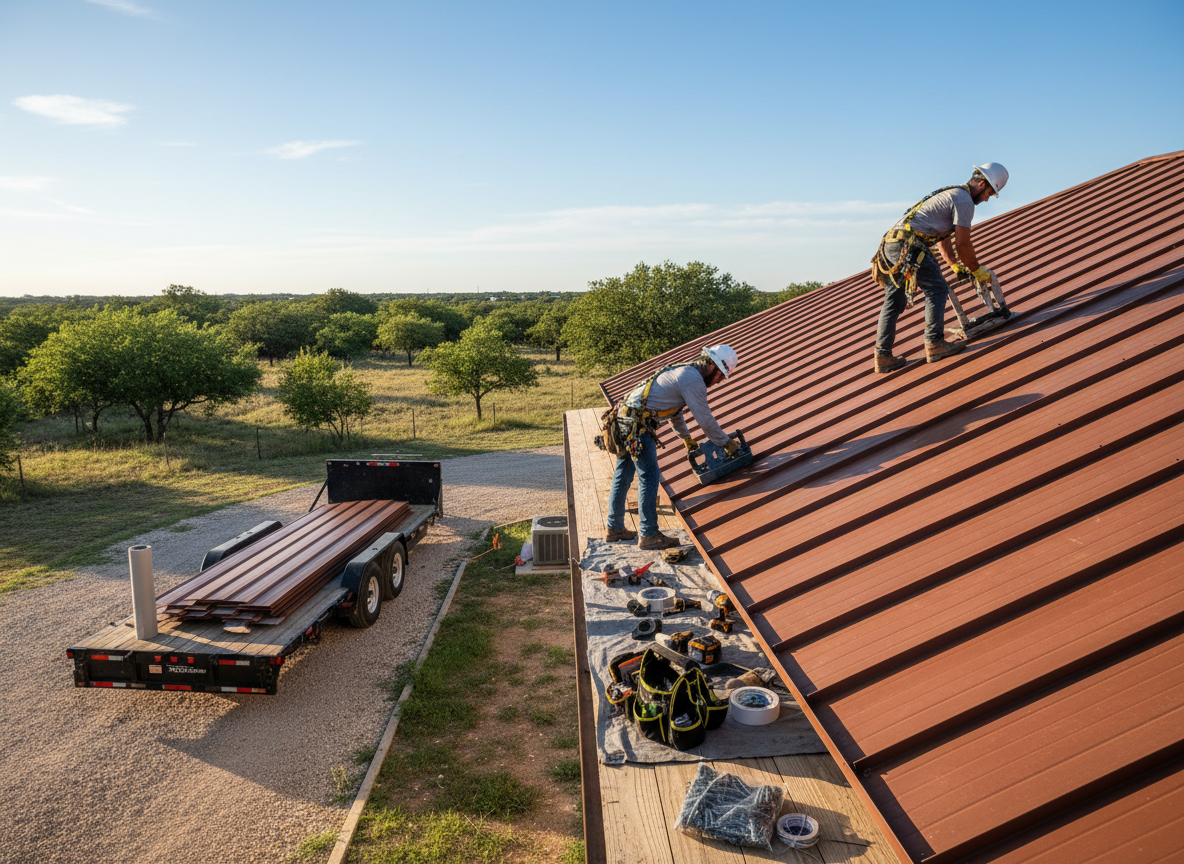
- Material-Specific Roofing — asphalt shingle, standing-seam and panel metal, tile, and low-slope systems such as TPO and modified bitumen.
Hail, Wind, and Storm Damage Roofing in Arlington
Arlington sits in a corridor where spring supercells track northeast along I-20 and I-30, and the damage they leave is rarely uniform. One side of a roof can be peppered with bruised shingle mat while the other side looks untouched; wind can peel ridge caps and rake edges while the field stays flat. Because that pattern is so common here, a useful storm inspection documents what is actually damaged — soft spots in the mat, exposed fiberglass, granule loss in gutters and downspouts, dented vents and gutters — rather than relying on a verbal description.
If you plan to file an insurance claim, the scope and photos should be ready before the adjuster arrives, and the final scope should match the work that gets done. Coverage, deductibles and timelines are set by your policy and your carrier, not by us, so we keep the conversation on documentation and workmanship. Roof repair and roof replacement after a storm are both legitimate outcomes; the deciding factors are how much of the field is compromised and whether the deck and flashing can be reused.
Roofing Materials and Systems Common Across Arlington
Around Arlington
We regularly work near:
- 📍AT&T Stadium
- 📍Globe Life Field
- 📍Six Flags Over Texas
- 📍University of Texas at Arlington
- 📍Downtown Arlington
Roof Repair in Arlington — Local Notes
- •Housing stock and age vary sharply by neighborhood: post-war and mid-century homes around Downtown and North Arlington often carry a second layer of shingles and original or aging flashing, while newer two-story builds in South Arlington and toward Mansfield and Grand Prairie typically have steeper pitches, more complex rooflines and heavier reliance on proper intake and ridge ventilation.
- •Weather exposure is a two-part problem — summer UV and heat age shingle mat and sealant joints from above, while spring hail and straight-line wind along the I-20 and I-30 corridors crack tabs, lift ridge caps and open penetrations. Mild winters still produce hard freezes that shrink and split sealant around vents and chimney counterflashing.
- •Access and scheduling matter: narrow driveways and mature tree canopy in older blocks complicate material staging and drop debris into valleys, event-day traffic near AT&T Stadium, Globe Life Field and UT Arlington slows crew movement, and re-roof permit requirements are jurisdiction-dependent and should be confirmed with the City of Arlington for the specific scope.
Nearby cities we serve