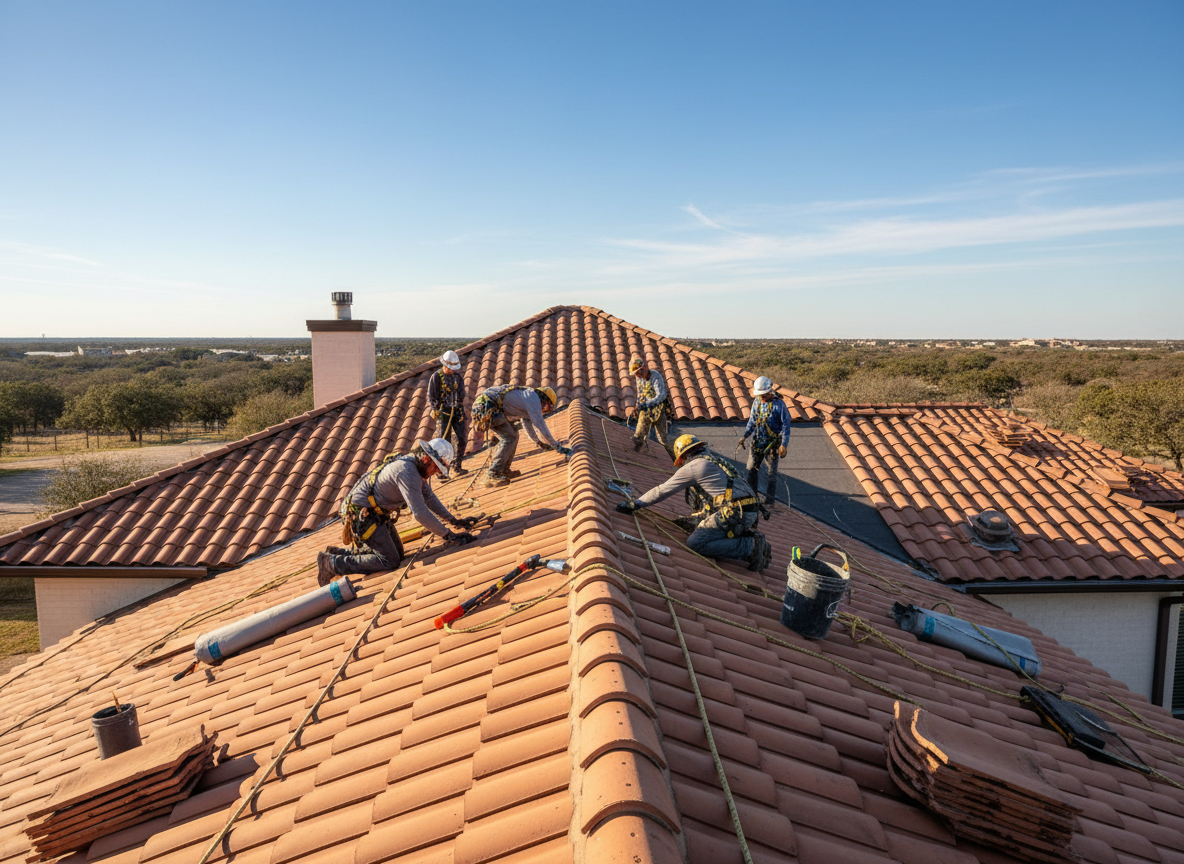
A roof leak in Houston rarely announces itself where it starts. Water enters at a failed pipe boot, a lifted valley, a chimney counterflashing or a nail pop, then travels along decking, insulation and framing before it stains a ceiling three rooms away. In a subtropical climate with hot, humid summers and mild winters, that hidden travel is the norm rather than the exception — attics stay warm and humid, sheathing stays damp, and a small opening can feed mold long before a homeowner notices a brown ring on the drywall. Roof leak repair here is a diagnosis job first and a construction job second, and the two should never be reversed.
The neighborhoods we serve shape the work. In Montrose, the Heights and Midtown, you find a mix of 1920s bungalows, mid-century ranches and newer infill, often with original pier-and-beam framing, mature pecan and oak canopy, and roofs that have been layered or patched over decades. River Oaks and the Memorial-area homes tend to carry steeper, more complex rooflines with multiple valleys, dormers and chimneys — more places for flashing to fail. Out toward Katy, Sugar Land and Pearland, the housing stock is newer and larger, but it sits fully exposed to Gulf-driven wind and hail, with fewer trees to break the weather and more roof plane to inspect.
Houston's weather does specific damage. Summer UV bakes sealant, pipe boots and ridge caps until they crack; surface temperatures on a dark shingle roof can climb well past ambient. Then a spring or fall storm drops heavy rain sideways, and wind-driven water finds every gap in step flashing and every lifted shingle tab. Hail adds impact bruising that knocks granules loose and fractures mat, which shows up as a leak months later. Because freeze events are rare but not unheard of, homeowners often skip the winter checks that northern markets take for granted — which is exactly when a small flashing gap becomes a ceiling stain.
Roof leak repair is appropriate when the roofing system is otherwise sound: the leak is localized, the decking beneath it is still solid, and the surrounding field of shingles, tile or membrane has useful life left. It is the wrong answer when water has been entering for seasons, when decking is soft or delaminated, when the same slope has been patched repeatedly, or when hail or wind has compromised a wide area. A roof replacement conversation should be honest and specific — not a sales pivot. If a repair will hold, we say so; if it will not, we explain what we found and why, and let you decide with real information in hand.
Common Signs and Failure Modes of a Roof Leak
Water almost never shows up where it enters. Watch for ceiling or wall stains that grow after rain, bubbling or peeling paint on a soffit, dark streaks on attic sheathing, damp or matted insulation, a musty smell in a closet or hallway, and rust on attic nails or HVAC hangers. On the roof itself, the usual culprits are cracked or missing pipe boots, dried and separated sealant at counterflashing, corroded valley metal, lifted or creased shingle tabs, exposed or popped fasteners, failed ridge and hip caps, and ponding on low-slope sections that never drains. In Houston's older inner-loop housing, deteriorated chimney flashing and worn step flashing along a wall are recurring offenders; on newer suburban roofs, wind-lifted tabs and hail-bruised shingles tend to lead.
Roof Systems We Repair and How Each One Fails
Asphalt shingle is the most common roof in Harris County and the most repairable. It fails at sealant, fasteners and flashing long before the field wears out. Repairs work well when the surrounding shingles are pliable and matching material is available; they are a poor fit on a brittle, granule-bare roof where every repair disturbs more tabs. Metal roofing — standing seam and exposed-fastener panels alike — leaks at fastener gaskets, panel laps, end laps and transitions, and repairs must respect thermal movement rather than simply sealing a joint rigid. Tile and clay roofs shed water well but rely on underlayment for the actual waterproofing; a cracked tile is rarely the leak, and walking a tile roof incorrectly causes more damage than the original problem. Flat and low-slope sections — common on Midtown and Downtown commercial buildings, garages and additions — use TPO, modified bitumen or built-up membrane, where seams, penetrations, drains and ponding are the failure points and where a coating is a maintenance measure, not a cure for a saturated assembly.
How Leak Diagnosis Works on a Houston Roof
Diagnosis starts inside. We map the stain, then inspect the attic for the water path, looking at sheathing staining, insulation condition and framing before we ever go up. On the roof, we check penetrations, valleys, transitions and terminations in the uphill direction from the interior evidence, because water follows gravity and framing. Where the source is ambiguous, a controlled water test isolates one area at a time, and a moisture meter confirms whether an area is actively wet or has dried. Attic humidity after a Houston summer can confuse the picture, so we distinguish active intrusion from old staining. Only after the source is identified do we talk about scope — repairing the wrong area is the most expensive mistake in this trade.
Repair or Replace? Factors That Decide It
The honest factors are age and remaining life of the roof system, how much area is affected, whether decking is structurally sound, how many previous repairs sit on the same slope, and whether the damage is impact-related across a broad field. A single flashing failure on a twelve-year-old architectural shingle roof is a repair. A twenty-year-old three-tab roof with hail bruising, soft decking and water that has been entering for two rainy seasons is a replacement, and patching it just moves the problem. We also weigh whether the roof can be repaired without disturbing brittle material, and whether matching shingles, tile or membrane are still available. You get the findings, the options and the trade-offs in plain language.
Permits, HOA Rules and Local Requirements
Permit and code requirements for roofing work vary by municipality across the Houston area and across Texas, and they change. The City of Houston, Katy, Sugar Land, Pearland and unincorporated Harris County do not all treat roof repair and roof replacement the same way, and some jurisdictions require a permit or inspection for structural repairs, decking replacement or full re-roofs while allowing minor repairs without one. Deed restrictions and HOA architectural review can also govern material, color and visible changes in subdivisions and in historic districts. Confirm what applies to your specific address before work begins — we will tell you what we know, but the requirement is set by your local authority.
Preventing the Next Leak
Most Houston roof leaks are maintenance failures, not mysteries. Clear debris from valleys, behind chimneys and around drains before and after storm season, since pine straw and leaf litter hold moisture against the roof surface. Have pipe boots, counterflashing and sealant joints checked annually — UV degrades them faster here than in cooler climates. After any hail event, look for granule accumulation in gutters and downspouts, which signals shingle surface loss. Keep attic ventilation working so humid air does not condense on the underside of the deck, and address small ceiling stains promptly rather than waiting for the next storm to widen them. A short inspection after each major weather event costs far less than the drywall, insulation and mold work a slow leak creates.
Technician insight
In Houston, the thing that catches most people out with Roof Leak Repair is that the stain on the ceiling is almost never under the hole. Water gets in at a valley or a chimney flashing on the north side, runs down the underside of the deck, hits a framing member and drops somewhere else entirely — so homeowners patch the spot above the stain and the leak keeps coming back. The other local factor is attic humidity: after a Houston summer, everything up there feels damp, so old staining and active intrusion look alike until you meter it. Confirm the source before you spend a dollar on materials.
Ceiling stain two rooms away from the actual leak
A homeowner in a 1950s Heights bungalow called about a brown ring spreading on a bedroom ceiling after a spring storm, and had already had the shingles above that room resealed once with no result. We inspected the attic first and found the water path running along a framing member from the opposite slope, where the chimney counterflashing had separated and the step flashing behind it had corroded through. We replaced the counterflashing and the affected step flashing, resealed the transition, and verified with a controlled water test. The ceiling stain stopped growing, and the homeowner avoided paying for a second round of shingle work in the wrong place.
Roof Leak Repair Services We Offer
✓Roof Leak Detection and Attic Water Tracing
Interior and attic inspection to trace where water is actually entering, using staining patterns, framing paths and moisture readings rather than guesswork. This is the step that determines whether a repair targets the right area.
✓Flashing Repair at Chimneys, Walls and Valleys
Repair of step flashing, counterflashing, valley metal and wall transitions, which are the most common leak points on Houston roofs. Includes resealing and, where needed, replacement of deteriorated metal.
✓Storm and Hail Leak Repair
Assessment and repair after wind-driven rain, hail or tropical weather, including lifted shingle tabs, bruised mat, displaced ridge caps and impact-damaged penetrations. Broad impact damage may point toward replacement rather than patching.
✓Asphalt Shingle Roof Leak Repair
Targeted repair of shingle roofs at fasteners, sealant lines, pipe boots and field damage where the surrounding shingles still have useful life. Not appropriate on brittle, granule-bare roofs where repair disturbs more material than it saves.
✓Metal Roof Leak Repair
Repair of standing seam and exposed-fastener metal roofs at fastener gaskets, panel laps, end laps and transitions, with detailing that allows for thermal movement instead of rigid sealing.
✓Tile and Clay Roof Leak Repair
Repair of tile roofs where the underlayment, not the tile, is doing the waterproofing — addressing failed underlayment, broken tiles, and flashing at valleys and penetrations without damaging surrounding tile.
✓Flat and Low-Slope Roof Leak Repair
Repair of TPO, modified bitumen and built-up membrane sections on garages, additions and commercial buildings, focused on seams, penetrations, drains and ponding. Coatings are discussed as maintenance, not as a fix for a wet assembly.
How it works
- 1
Interior and Attic Assessment
We start inside, mapping the stain and inspecting the attic for sheathing staining, damp insulation and the framing path water is following. This narrows the search area before anyone gets on the roof.
- 2
Roof-Level Inspection and Source Confirmation
We inspect penetrations, valleys, flashing, terminations and field material uphill from the interior evidence, and confirm active moisture with a meter or a controlled water test where the source is ambiguous.
- 3
Scope and Options Review
You get the findings in plain language: what failed, what a repair involves, what it will and will not address, and whether replacement is the more sensible spend given the roof's age and condition.
- 4
Repair and Verification
We complete the repair with material matched to the existing system, then verify the area is watertight and check that the repair has not created a new transition problem nearby.
Pricing
Roof leak repair pricing in the Houston area depends far more on access and scope than on a flat rate. A single pipe boot or a short flashing reseal is a small job. A leak that requires removing and reinstalling field shingles, replacing valley metal, or working on a steep, multi-story or tile roof takes materially more labor. Access matters — a two-story River Oaks roofline with dormers and valleys costs more to reach than a single-story Pearland ranch. If diagnosis reveals soft decking, saturated insulation or damage across a wide area, the scope shifts from repair toward replacement, and the price reflects that. You receive the scope in writing before work starts.