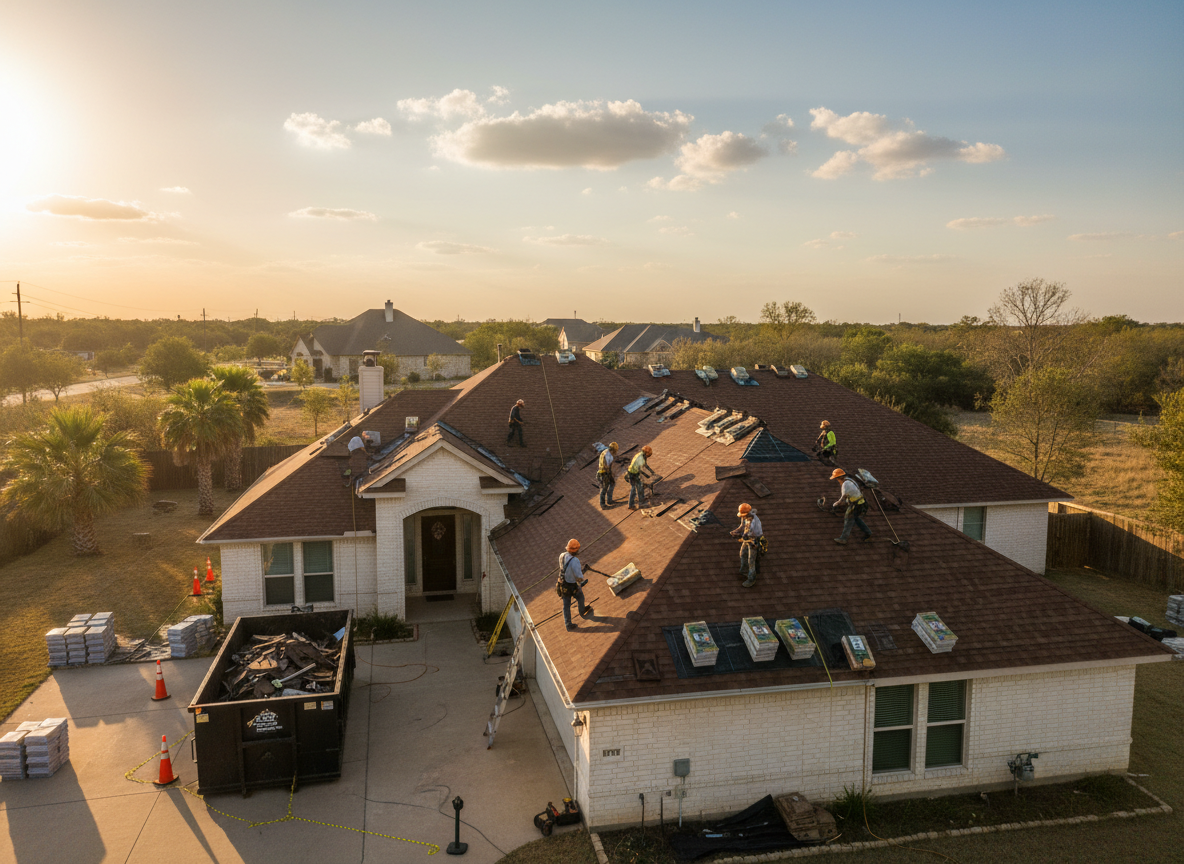
Roof replacement in Houston is less about picking a shingle color and more about picking a system that survives a subtropical climate. Harris County roofs take intense summer UV, months of humidity, and repeated hail and wind events, sometimes all in the same year. Homes in the Heights, Montrose and River Oaks often carry original or second-layer roofs over older decking, while newer construction out in Katy, Sugar Land and Pearland may have a builder-grade roof reaching the end of its service life sooner than the homeowner expected. A replacement done right starts with an honest assessment of decking, underlayment, flashing and ventilation — not just the visible surface.
Once summer temperatures settle into the mid-90s with high humidity, asphalt shingles age from the top down while the attic cooks from the inside. Granule loss, curling and thermal cracking show up first on south- and west-facing slopes. Humidity is the quieter problem: it drives algae streaking, softens sealant around pipe boots and valleys, and lets water creep into decking that looks fine from the ground. Attic ventilation matters as much as the roof surface — a hot, poorly vented attic shortens shingle life and pushes cooling costs up. When we scope a replacement, ventilation, underlayment and flashing are treated as part of the system, because new shingles over failing components just reset the clock on the same problem.
Texas storm seasons do the structural damage. Hail bruises shingle mats and knocks granules loose, which rarely looks dramatic from the driveway but shows up as premature failure two or three summers later. Straight-line winds lift tabs, tear ridge caps and bend flashing at chimneys and sidewalls. Then heavy rain arrives and finds every one of those openings. Coastal-influenced storms push water sideways into places a roof was never designed to shed. That is why a replacement scope should include the details — drip edge, valley treatment, pipe boots, chimney and wall flashing, ridge and soffit ventilation — rather than just squares of shingle. Those details are what keep a Houston roof dry through the next storm.
Material choice should follow roof pitch, structure and neighborhood, not a sales pitch. Architectural asphalt shingles remain the most common choice across Houston for cost and availability, and they perform well when installed over proper underlayment with adequate ventilation. Standing-seam metal handles UV and heat well and sheds heavy rain, but it needs correct fastening and panel detailing to avoid oil-canning and fastener issues. Tile and concrete roofing suit steeper, structurally capable homes in areas like River Oaks and Montrose, but they are heavy and require framing that can carry the load. Flat and low-slope sections — common on Midtown and Downtown properties, garages and additions — call for a membrane system such as TPO, not shingles.
Not every roof needs replacing. A single active leak traced to a failed pipe boot, a torn valley or a lifted ridge cap is usually a repair. Replacement becomes the sensible call when damage is widespread, when the roof is on its second or third layer, when decking is soft or delaminating, or when repeated repairs are adding up faster than a new system would. Age matters, but it is not the whole story — a 15-year-old roof with good ventilation and no storm damage can outlast a 10-year-old roof that has been hail-hit twice. The honest answer comes from walking the roof, checking the attic and looking at the underside of the deck, not from a curb-side glance.
What a Roof Replacement Inspection Should Cover
A replacement scope should be built from what is actually on the roof, not from a square-footage number. Expect the assessment to cover:
- Decking condition — soft spots, delamination, water staining and previous patchwork, checked from the attic side where accessible.
- Layers — how many roofs are already up there, since tear-off versus overlay changes both cost and ventilation.
- Underlayment and ice-and-water detailing — especially at valleys, penetrations and low-slope transitions.
- Flashing — chimney, sidewall, headwall, step flashing, drip edge and pipe boots, all of which fail before shingles do.
- Ventilation balance — intake at soffit or eave, exhaust at ridge or static vents, and whether attic insulation is blocking airflow.
- Drainage — gutters, downspouts and any ponding on flat sections.
- Penetrations — satellite mounts, solar attachments, HVAC curbs and skylights, which are common leak sources in Houston homes.
If a contractor quotes a replacement without getting on the roof or into the attic, the scope is a guess.
Permits, HOA Rules and Neighborhood Considerations
Roofing permits are handled differently from one municipality to the next across the Houston area and Texas generally, and requirements can change. Some jurisdictions require a permit and inspection for a full tear-off and re-roof; others treat residential re-roofing differently than commercial or low-slope work. Unincorporated areas may fall under county rules rather than a city department. Confirm the permit requirement for the specific address before work begins, and confirm who pulls it — that should be settled in writing, not assumed.
Deed restrictions and HOA architectural review are a separate layer. Neighborhoods in River Oaks, the Heights and Montrose, along with many master-planned communities in Katy, Sugar Land and Pearland, may restrict material type, color, and sometimes visible metal or tile. Approval usually has to happen before materials are ordered, and a rejected color choice after tear-off is an expensive problem.
What to Discuss With Your Contractor
Before signing anything, get clear answers on these points and keep them in the written scope:
- Whether the job is a full tear-off or an overlay, and why that choice was made.
- How many layers exist now and how they will be disposed of.
- What underlayment and flashing products are specified, by name.
- How decking damage will be handled — priced per sheet, or included up to a limit.
- Ventilation changes, if any, and whether they are part of the quote.
- Who pulls the permit and who schedules any inspection.
- How the roof will be protected if rain moves in mid-job, which happens often here.
- Cleanup expectations: magnetic sweep for nails, landscaping protection, dumpster placement.
- Payment schedule tied to milestones rather than a large deposit up front.
- What the workmanship coverage covers and how long it runs — ask for it in writing.
Cost Factors for Roof Replacement in Texas
Pricing for a Houston-area roof replacement moves with a handful of variables rather than one flat rate:
- Roof size and complexity — pitch, hips, valleys, dormers and cut-up sections add labor and waste.
- Layers and tear-off — removing two or three layers costs more than one, and disposal adds up.
- Decking replacement — soft or delaminated sheathing is usually priced per sheet once it is exposed.
- Material system — architectural shingles, standing-seam metal, tile and TPO membrane sit at very different price points.
- Flashing and penetration work — chimneys, skylights, solar mounts and multiple pipe boots.
- Ventilation upgrades — ridge vents, soffit baffles or new intake, if the attic is currently starved.
- Access and logistics — tight lots in Midtown or the Heights, steep driveways, or landscaping that needs protection.
- Permit and inspection fees, which vary by municipality.
A quote that is dramatically lower than the others usually means something in this list was left out.
Seasonal Timing and Storm Season in Houston
Roofing happens year-round here, but timing changes the experience. Late spring through early fall brings afternoon thunderstorms and the peak of hurricane-season moisture, which means more weather interruptions and more careful tarping between tear-off and dry-in. Summer heat is hard on crews working a hot deck, and shingle sealant strips need warm sun to activate properly — which is actually an advantage in a Houston summer.
Winter is milder and often easier to schedule, but short daylight and occasional cold snaps slow sealant curing. If a roof is actively leaking, the priority is stopping water intrusion now and scheduling the replacement around it, rather than waiting for a perfect weather window that may not arrive.
Technician insight
In Houston, the thing that catches most people out with roof replacement is that the leak they called about is almost never the shingles — it is usually a pipe boot, a valley, or flashing at a chimney or sidewall that gave out years earlier. The second surprise is decking: in this humidity, sheathing behind an old underlayment can be soft and stained even when the roof looks intact from the street, and that only shows up after tear-off. Homes in the Heights and Montrose with two or three layers up top are the ones where the scope changes mid-job, so it pays to have decking priced per sheet in writing before anyone starts.
Three-Layer Roof on an Older Heights Bungalow
A homeowner called about a ceiling stain that kept returning after two previous patch jobs. On the roof we found three layers of shingles, a valley that had been tarred over, and soft decking along the north slope where water had been sitting under the old underlayment. We tore off all three layers, replaced the damaged sheathing, rebuilt the valley with new flashing, and re-roofed with architectural shingles plus corrected ridge and soffit ventilation. The ceiling stain stopped recurring, and the homeowner finally had a scope that explained where the water had actually been going.
Roof Replacement Services We Offer
✓Asphalt Shingle Roof Replacement
Full tear-off and replacement with architectural asphalt shingles, the most common system on Houston-area homes. Scope covers decking repair, underlayment, flashing and ventilation so the new surface is not sitting on failed components.
✓Metal Roof Replacement
Standing-seam and metal panel systems for homeowners wanting long service life and better heat performance. Correct fastening, panel detailing and thermal movement are handled at install, since poor detailing is what causes oil-canning and fastener leaks.
✓Tile and Concrete Roof Replacement
Clay, concrete and similar heavy roof systems suited to steeper, structurally capable homes. Framing capacity, underlayment replacement and breakage allowance are confirmed before work starts, because tile weight and fragility change the job.
✓Flat and Low-Slope Roof Replacement
TPO and membrane replacement for flat or low-pitch sections on homes, garages, additions and commercial buildings. These systems need welded seams, proper insulation and positive drainage rather than shingles.
✓Storm and Hail Damage Roof Replacement
Replacement scoped around hail bruising, wind-lifted tabs, torn ridge caps and bent flashing. Damage is documented slope by slope, and the scope separates storm-related work from ordinary wear.
✓Roof Decking and Underlayment Replacement
Replacing soft, delaminated or water-stained sheathing and upgrading underlayment at valleys and penetrations. Often the difference between a roof that lasts and one that leaks again in two seasons.
✓Flashing and Ventilation Upgrade
Chimney, sidewall, valley and pipe-boot flashing work plus ridge and soffit ventilation corrections. Frequently the real source of a leak that was blamed on the shingles.
How it works
- 1
Roof and Attic Assessment
We look at the roof surface, the flashing details and the attic side of the decking, and note layers, ventilation and drainage. The goal is a scope built from actual conditions rather than square footage alone.
- 2
Scope and Material Options
You get a written scope covering tear-off or overlay, underlayment and flashing products, decking allowances and ventilation, plus material options matched to your roof pitch, structure and neighborhood rules.
- 3
Permits and Scheduling
Permit requirements vary by municipality, so we confirm what applies to your address and who pulls it. HOA or deed-restriction approvals are settled before materials are ordered.
- 4
Tear-Off and Dry-In
Old roofing is removed, decking is inspected and repaired, and underlayment and flashing go down before the finished surface. Weather protection is planned for every stage, since Houston rain does not wait.
- 5
Install, Cleanup and Walkthrough
The new system is installed, ventilation and flashing are finished, and the site is swept for nails. You walk the finished roof with us and get the scope and coverage details in writing.
Pricing
Roof replacement pricing in the Houston area is quoted per job, not per square foot alone — layers to remove, roof complexity, decking condition, material system and ventilation all move the number. Expect a written scope with decking priced per sheet rather than a single lump figure.