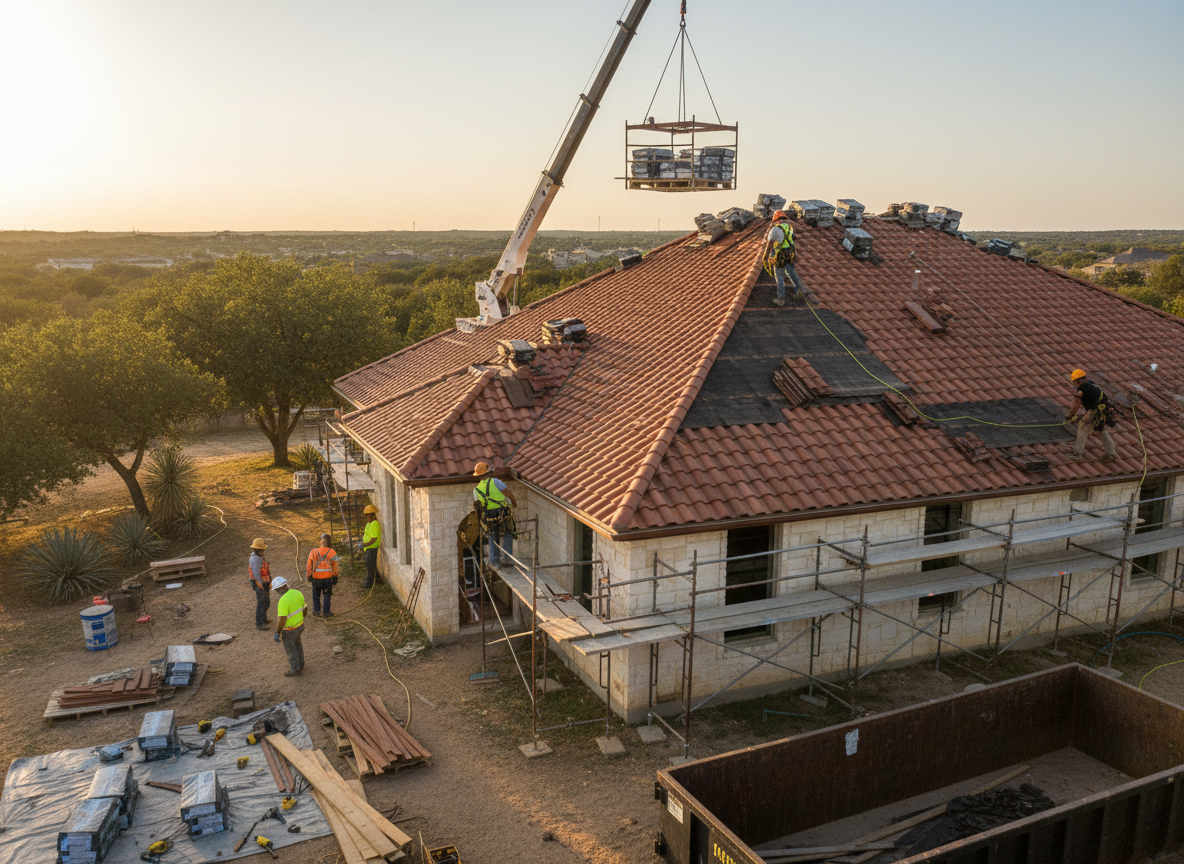
Residential Roofing in Houston and Across Texas
Residential roofing in this part of Texas is a different job than it is almost anywhere else. Summers run hot and humid from May well into September, winter is short and mild, and the damage that matters usually arrives sideways — hail, straight-line wind, and the heavy rain bands that come with Gulf storms. A roof in Montrose, River Oaks or the Heights is also sitting on older framing and decking than a newer build out in Katy or Sugar Land, so what is under the shingles matters as much as what is on top. We handle roof repair, roof replacement and the diagnosis in between, and we say plainly when a repair will do the job and when it will not.
How Houston-Area Roofs Actually Fail
Most roof failures here start small and show up late. Granule loss on asphalt shingles is accelerated by UV and by attic heat radiating from below, so shingles that are only a few years old can already be brittle. Hail bruises the mat and knocks granules loose without always tearing the surface, which is why a roof can look intact from the driveway and still leak. Wind lifts and creases shingle tabs along ridges, hips and gable ends. On the flat and low-slope sections common on Midtown and Downtown-area properties, ponding water and failed seams do the damage. Inside, the first signs are usually attic staining, a ceiling spot, or daylight showing at a valley.
Roof Systems and Materials: What Fits Which House
Architectural asphalt shingles remain the default across Harris County — cost-effective, widely repairable, and capable of handling Texas sun when attic ventilation is right. Standing-seam and exposed-fastener metal roofing suits homeowners who want long service life and better heat reflection, though metal needs careful detailing at penetrations and benefits from solid decking under it. Clay and concrete tile fits the Spanish and Mediterranean architecture common around River Oaks and Montrose, but tile is heavy and needs framing and flashing that can carry the load. For genuinely flat and low-slope areas, TPO, modified bitumen and reflective coatings are the practical choices — shingles should never be laid on a low-slope roof.
Diagnosis and Inspection: What a Proper Look Covers
A useful inspection goes well past the view from the driveway. It means getting into the attic to check decking, rafters, insulation staining and ventilation; walking the roof where it is safe to do so; and checking the details that actually leak — pipe boots, chimney and sidewall flashing, valleys, drip edge, ridge caps, and penetrations from vents or satellite mounts. On older Heights and Montrose homes we look at the plank decking and how many shingle layers are already in place, because both change how a repair or replacement gets done. After a hail or wind event, we photograph what we find so you have a record of the condition, whether or not you file a claim.
Roof Repair vs. Roof Replacement
Repair makes sense when the damage is localized: a failed pipe boot, a torn valley, a handful of wind-lifted shingles, or a leak traced back to one flashing detail. Replacement becomes the better call when shingles are brittle across the whole field, when granule loss is widespread, when there are multiple active leaks, when the roof is at or near the end of its service life, or when adding a second layer would trap heat and add weight. Age alone is not the deciding factor — condition is, along with what it will cost to keep chasing leaks. We lay out both paths and what each involves so you can make the call.
Permits, HOA Rules, and Local Requirements
Roofing permits and inspection requirements vary by municipality across the Houston area, and they change. The City of Houston, Katy, Sugar Land and Pearland do not all handle re-roofing the same way — some jurisdictions require a permit for a full replacement, some only for structural work, and some want documentation of what was removed. Deed restrictions and HOA architectural review can also dictate shingle color, profile, and whether metal is allowed at all. Confirm what applies to your specific address before work begins. We will tell you what we know about your area, but the requirement is set by your city or your HOA, not by the contractor.
Technician insight
In Houston, the thing that catches most people out with Residential Roofing is that a ceiling stain in a Montrose or Heights bungalow is usually nowhere near the actual breach — wind-driven rain pushes water sideways along the decking and it drops in at the first gap it finds. The other one is attic heat: with poor ventilation, the underside of the sheathing cooks at temperatures that age shingles from below, so a roof that looks fine from the street can be close to the end of its life. Get the attic looked at, not just the shingles.
Ceiling Stain in a 1950s Heights Bungalow
A homeowner called after a brown stain spread across a bedroom ceiling following a heavy rain band, but nothing on the roof looked obviously torn. The inspection found the leak was not above the stain at all — a cracked pipe boot and a rusted sidewall flashing were letting water in, which then ran along the original plank decking before dropping through a seam. We replaced the boot, rebuilt the sidewall flashing, replaced the damaged shingles in that area, and checked the rest of the field, which was still serviceable. The ceiling stayed dry through the next round of storms.
Residential Roofing Services We Offer
✓Roof Repair
Targeted repair of localized damage — torn or lifted shingles, failed flashing, damaged valleys and leaking penetrations. Best when the rest of the roof field is still sound and the problem can be traced to a specific area.
✓Roof Replacement
Full tear-off and replacement of a residential roof system, including decking assessment, underlayment, flashing and ventilation. Appropriate when shingles are brittle across the field or multiple leaks are active.
✓Roof Leak Detection and Repair
Tracing an active leak from the interior stain back to its actual source in the attic and on the roof deck. Water in Houston often travels sideways along decking before it drops, so the entry point is rarely directly above the stain.
✓Hail and Wind Damage Roof Repair
Assessment and repair after spring hail or straight-line wind events, including bruised shingle mats, creased tabs and damaged ridge and hip caps. We document conditions with photos so you have a record of what was found.
✓Asphalt Shingle Roofing
Architectural and three-tab shingle installation and repair, the most common roof type across Harris County. Performance depends heavily on attic ventilation, since heat from below ages shingles from the underside.
✓Metal Roofing
Standing-seam and exposed-fastener metal roof installation and repair, valued for heat reflection and long service life. Requires careful detailing at penetrations and solid decking to manage noise and movement.
✓Flat and Low-Slope Roofing
TPO, modified bitumen and coating systems for flat and low-slope roof sections on homes, garages and additions. These areas need membrane systems rather than shingles, and they fail at seams and ponding points.
How it works
- 1
Inspection and Findings
We look at the roof from the ground and from the deck where it is safe, then get into the attic to check decking, rafters, insulation staining and ventilation. The details that actually leak — pipe boots, valleys, chimney and sidewall flashing, drip edge — get checked individually.
- 2
Written Scope and Options
You get a written scope naming the materials, the areas being worked, and what is being removed. If repair and replacement are both realistic, we lay out both with what each involves so the decision is yours.
- 3
Tear-Off and Deck Preparation
Existing layers come off, the deck is inspected for soft or delaminated sheathing, and any rot or damaged plank decking is addressed before anything new goes down. This is the stage where the scope sometimes changes, and it gets documented before extra work proceeds.
- 4
Installation and Detail Work
Underlayment, flashing, valleys, pipe boots and ridge details go in before the field material, because those details are what fail first. Shingle, metal, tile or membrane goes on according to the system the roof actually calls for.
- 5
Final Walkthrough and Cleanup
We walk the finished roof with you, review what was done, clear gutters of debris, haul off tear-off material and sweep the yard and driveway for nails. Anything you want re-checked gets noted before we close out the job.
Pricing
Residential roofing pricing in the Houston area is driven by roof size and pitch, how many layers have to come off, the condition of the decking, the material chosen, and how many valleys and penetrations the roof has. Flat and low-slope sections, tile and metal all price differently from asphalt shingle, and storm repairs are usually quoted per area rather than per shingle. Expect the number to move if soft decking turns up once the roof is open — that is normal, and it should be documented in writing before extra work proceeds.