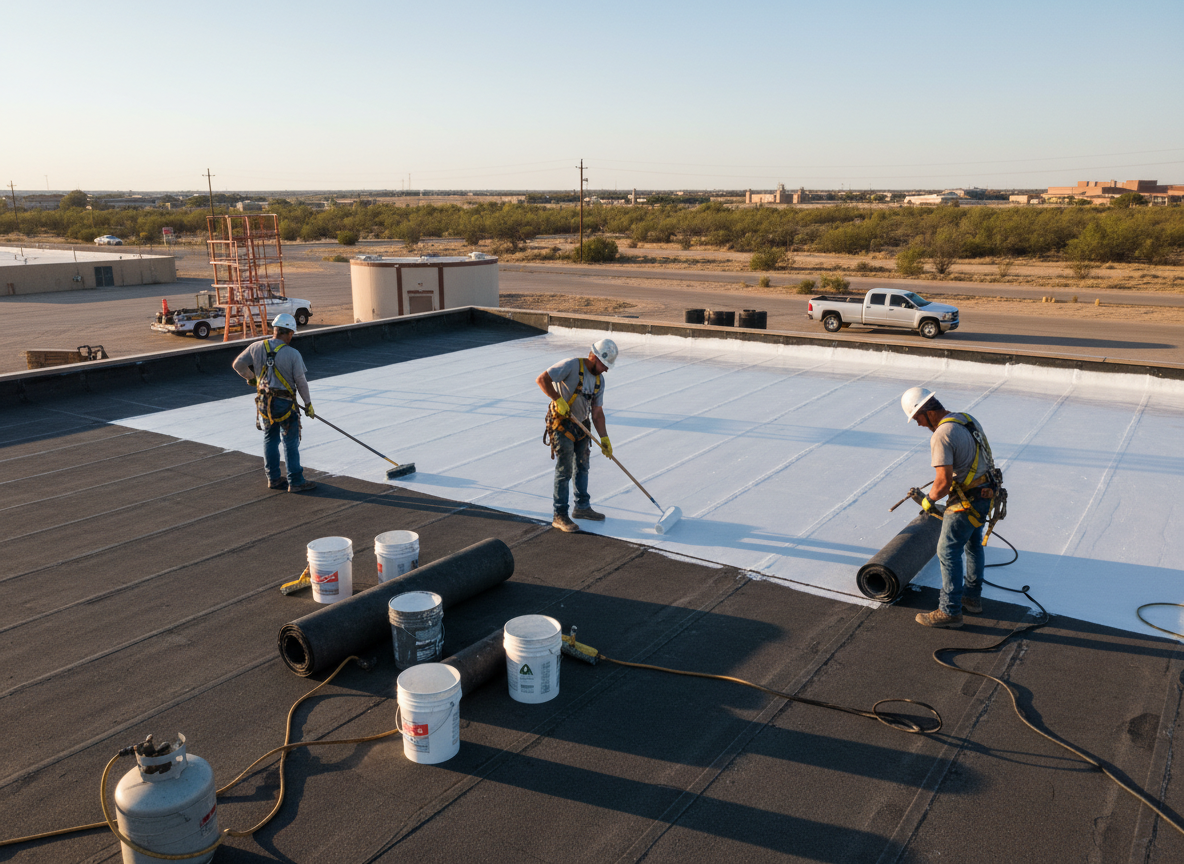
Flat Roof Repair in Houston and Across Texas
A flat roof is never truly flat — it relies on a slight slope, a continuous membrane and sealed seams to move water off the deck. In the Houston area, with its subtropical pattern of hot, humid summers and mild winters, that system is under constant stress. UV breaks down the top surface of the membrane, thermal cycling works the seams loose, and a summer downpour or a tropical system pushes water against details that were marginal to begin with. If you own a home in the Heights or Montrose with a low-slope addition, a garage roof, or a patio cover, or you manage a small commercial building near Downtown or Midtown, flat roof repair is usually about finding where water is actually getting in — not just where the stain shows up on the ceiling.
Why Low-Slope Roofs Fail Differently Than Shingle Roofs
On a pitched asphalt shingle roof, water sheds fast and gravity does most of the work. On a low-slope roof, water lingers. That means small defects matter more: a lifted seam, a failed pipe boot, a crack at a drain collar, or a blister where trapped moisture has pushed the membrane away from the substrate. Ponding water — the kind that sits for more than a day or two after rain — is the single biggest long-term threat, because it accelerates membrane breakdown and finds every weak point. Hail along the Katy and Sugar Land corridors can bruise or fracture certain membranes without punching a visible hole, and wind from a Gulf storm can peel back edge metal and open up the perimeter before you ever see a drip inside.
Diagnosis Comes Before Repair
A proper flat roof repair starts with an inspection that traces water back to its entry point, not its exit point. Water can travel a long way along a deck before it drops through a ceiling, so the interior stain is often nowhere near the actual breach. A roofer should walk the roof, check seams, terminations, drains, scuppers, penetrations and flashings, and look for soft spots that suggest saturated insulation or decking underneath. In older Houston neighborhoods — River Oaks, the Heights, parts of Montrose — you will often find layered roof systems where a previous coating or membrane was applied over an older one, which changes both the diagnosis and the repair approach.
Repair or Replace: An Honest Threshold
Not every flat roof needs to be torn off. If the membrane is sound, the insulation is dry and the problem is isolated to a seam, a flashing or a drain detail, a targeted repair is the sensible call. Replacement becomes the better answer when ponding is structural rather than incidental, when the membrane is at the end of its service life across most of the surface, when there are multiple active leaks, or when the deck or insulation is saturated. Because local permits vary by municipality — Houston, Katy, Sugar Land and Pearland each handle re-roofing and structural work differently — confirm what your specific jurisdiction requires before w
Symptoms That Point to a Flat Roof Problem
Watch for ceiling or wall staining that reappears after heavy rain, a persistent musty smell in a room under the low-slope section, bubbling or blistering on the membrane surface, visible ponding that lingers more than 48 hours, granules or coating flakes collecting in gutters and drains, rusted or loose metal edge trim, and soft or spongy spots underfoot on the roof deck. On commercial low-slope roofs, also watch for ponding around drains and scuppers, open seams along the field of the membrane, and daylight visible at terminations. Any of these warrant an inspection before the next storm season.
Materials and Systems You Will See on Texas Low-Slope Roofs
TPO and PVC single-ply membranes are common on newer low-slope residential additions and small commercial buildings — they handle UV well and have heat-welded seams, but seam quality depends entirely on installer skill. Modified bitumen is the workhorse on many older Houston-area flat roofs; it is tough and repairable, but seams and flashings are its weak points over time. Built-up roofing (BUR) still exists on older buildings and can often be maintained with coatings rather than replaced. Sprayed or rolled elastomeric and acrylic coatings are a maintenance tool, not a cure — they can extend a sound membrane's life but will not fix active leaks or saturated insulation. Metal standing-seam panels appear on some low-slope commercial roofs, where the main issues are fastener back-out and sealant failure at penetrations.
What to Discuss With Your Contractor
Ask how they will determine where the water is actually entering, and whether they will check the deck and insulation for saturation rather than just the membrane surface. Ask what system they propose for the repair and why it suits your specific roof — a TPO patch, a modified bitumen repair and a coating are not interchangeable. Ask whether the repair will be compatible with the existing membrane if it is a different material. Ask about drainage: will they clear, repair or resize drains and scuppers as part of the job? Ask what local permits apply to your municipality and who pulls them. Ask how they will handle the transition details — edges, terminations, penetrations and flashings — since those are where most repairs fail again. Finally, ask what the workmanship scope covers and get it in writing.
Cost Factors for Flat Roof Repair
Pricing depends on the size of the repair area, the membrane type, and how much of the system has to come apart to reach the problem. A single seam or flashing repair is a very different job from removing saturated insulation and rebuilding a section of deck. Accessibility matters — a low-slope roof over a garage is straightforward, while a roof hemmed in by landscaping or a tight lot takes longer. Drainage corrections, new edge metal, and coating systems each add cost. Roof height, removal and disposal of old material, and whether the existing roof has multiple layers all move the number. Get the scope itemized so you can compare like for like rather than a single lump figure.
Technician insight
In Houston, the thing that catches most people out with flat roof repair is that the ceiling stain is almost never under the actual leak — water runs along the deck and drops somewhere else entirely, so a roofer who patches above the stain is guessing. The other local gotcha is ponding: in this humidity and rainfall pattern, water that sits more than a day or two is doing damage the whole time, and it usually means the slope or the drains need attention, not just the membrane. Older homes in the Heights and Montrose often have two or three layers of roofing stacked up, which changes how a repair has to be tied in.
Recurring ceiling stain on a low-slope garage roof in the Heights
A homeowner had a ceiling stain in a converted garage that kept coming back after heavy rain, and a previous patch above the stain had not stopped it. On inspection, the actual breach was a failed pipe boot several feet away, with water tracking along the deck before dropping through. The roofer replaced the boot, repaired a separated seam nearby, and cleared a partially blocked drain that had been letting water pond at that corner. The stain did not return through the following rainy stretch, and the homeowner was advised to keep the drain clear.
Flat Roof Repair Services We Offer
✓Low-Slope Leak Detection and Repair
Tracing an active leak through the membrane, seams and flashings to its actual entry point, then repairing that detail rather than patching the interior stain.
✓TPO and Single-Ply Membrane Repair
Heat-welded patches, seam repairs and termination fixes on TPO and PVC membranes, including penetrations, pipe boots and drain collars.
✓Modified Bitumen Roof Repair
Repair of torch-down and self-adhered modified bitumen systems common on older Houston-area flat roofs, focusing on seam separation and flashing failures.
✓Ponding Water and Drainage Correction
Addressing standing water by clearing or repairing drains and scuppers, correcting slope where feasible, and identifying whether ponding is structural.
✓Flat Roof Coating and Waterproofing
Elastomeric and acrylic coating systems used to extend the life of a sound membrane and improve UV and water resistance — not a substitute for repairing active leaks.
✓Flashing, Edge Metal and Penetration Repair
Repairing the perimeter, terminations, curbs and penetrations where wind and thermal cycling most often open a low-slope roof up.
✓Hail and Storm Damage Assessment
Inspecting a low-slope roof after hail or high wind for bruising, fractured membrane, lifted seams and displaced edge metal that may not show as an immediate leak.
How it works
- 1
Roof Inspection and Leak Tracing
The roofer walks the roof, documents the membrane condition, checks seams, drains, flashings and penetrations, and looks for ponding and soft spots. Interior moisture readings or a look at the ceiling below help connect the symptom to the source.
- 2
Repair Scope and Material Match
You get a written scope identifying the repair area, the proposed material and how it will tie into the existing membrane. If the existing system is layered or mixed, that gets factored in before work starts.
- 3
Surface Preparation and Repair
The repair area is cleaned and dried, failed material is removed, and the new membrane, patch or flashing is installed and sealed. Saturated insulation or decking discovered during the work is addressed as part of the scope.
- 4
Drainage and Detail Verification
Drains, scuppers and edge metal are checked and cleared, and all terminations and penetrations are verified. Water testing may be used to confirm the repair holds.
- 5
Final Walkthrough
You walk the roof with the contractor, review what was repaired, and confirm the drainage path is clear and the details are sealed.
Pricing
Flat roof repair pricing is driven by repair area, membrane type and how much of the system has to be opened up — a seam repair and a deck rebuild are not comparable jobs. Expect itemized scopes rather than a single lump figure.