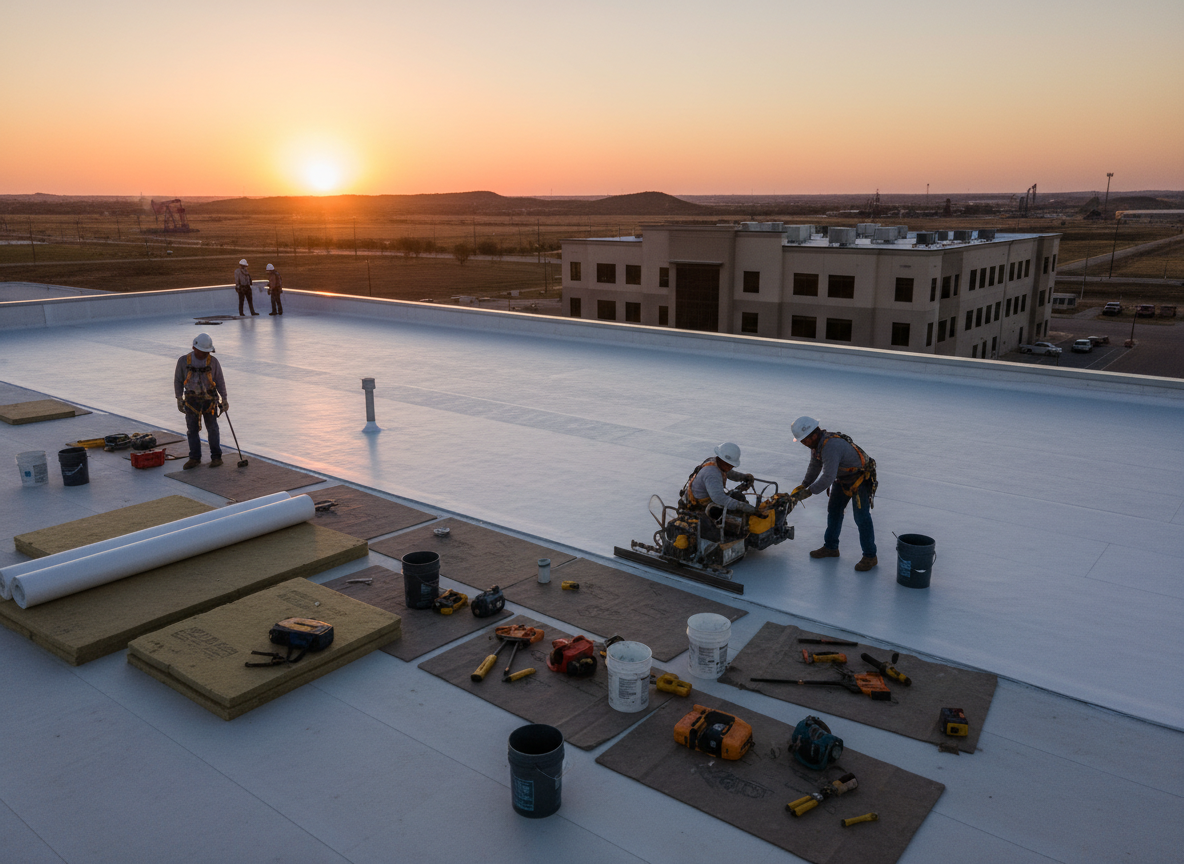
Low-slope roofing covers any roof pitched between roughly a quarter-inch and three inches per foot — flat enough to walk on, but still expected to shed water. In Houston that means far more than warehouses. The Heights and Montrose are full of 1920s–1950s bungalows with low-slope rear additions, garage apartments and porch roofs, while Midtown, Downtown and the blocks around the Museum of Fine Arts carry mid-rise commercial buildings with membrane roofs measured in thousands of square feet. Properties near Minute Maid Park and out toward Space Center Houston often mix low-slope sections into otherwise steep-sloped assemblies. Because these roofs sit nearly flat, they fail differently from shingle roofs: water lingers, seams and penetrations do the leaking, and small defects spread quickly.
Southeast Texas weather is hard on low-slope assemblies. Summers are hot and humid, and membrane surfaces routinely sit well above ambient air temperature, which drives expansion, seam stress and accelerated aging of asphalt-based products. Winters are mild enough that freeze-thaw is not the main threat, but the region makes up for it with tropical downpours that test drainage in minutes, plus hail and straight-line wind from spring and summer storms. UV exposure is relentless — it breaks down coatings, chalks and embrittles older modified bitumen, and degrades sealants around vents, drains and HVAC curbs. The practical result is that a low-slope roof here lives or dies on drainage and detailing, not on how thick the membrane happens to be.
Deciding between roof repair and roof replacement on a low-slope roof comes down to saturation, not appearance. A single failed seam or a cracked pipe boot on an otherwise sound TPO or modified bitumen field is a repair. But once moisture has migrated into the insulation or decking, patching the surface only hides the problem — the wet substrate keeps degrading and the leak reappears somewhere else. Age matters too: a decades-old built-up roof with granule loss and multiple prior patches rarely justifies another repair. We look at moisture readings, deck condition, drain and scupper capacity, the number and age of penetrations, and how the roof ties into walls and parapets. When a large share of the field is compromised, replacement usually costs less over the next decade.
Material choice should follow the building, not the sales pitch. TPO and PVC are common on Houston commercial and multifamily roofs because heat-welded seams hold up well and white membranes reflect summer sun. EPDM remains a solid, lower-cost option for simple, well-drained decks. Modified bitumen suits smaller residential low-slope areas and buildings where self-adhered or torch application is practical, though it ages faster under intense UV. Acrylic and silicone coatings can extend the life of a sound metal or bitumen roof, but they are not a fix for wet insulation or an active leak. On steeper low-slope runs, standing seam metal is often the better long-term answer.
Signs a Low-Slope Roof Is Failing
Flat and low-slope roofs rarely announce themselves. Most of the symptoms show up inside the building or at the edges:
- Ponding water that sits more than 48 hours after a storm, especially in the low corner of a garage apartment or behind a parapet.
- Ceiling stains or bubbling paint on the top floor, often far from where the actual breach is.
- Blistered, wrinkled or fish-mouthed membrane — trapped moisture or adhesive failure pushing the sheet up.
- Open seams and lap separation, most common on older modified bitumen and on any membrane installed over a damp deck.
- Granule loss and bare spots on cap sheet, exposing the asphalt to UV.
- Cracked or dried-out sealant around vents, HVAC curbs, drains and scuppers.
- Rusted or soft decking felt underfoot, and screws or fasteners backing out.
- Peeling coatings that lift in sheets after a summer — usually a sign the coating went over a wet substrate.
- Interior musty odor in Midtown and Downtown buildings where a saturated roof deck feeds humidity into the space below.
Low-Slope Roof Systems and Where Each One Fits
TPO (thermoplastic polyolefin) — the workhorse for Houston commercial, multifamily and larger residential low-slope roofs. White and reflective, heat-welded seams, good resistance to ponding when the deck is properly sloped. Best on roofs with adequate drainage and clean, dry substrate. Not appropriate when the deck is already saturated or when foot traffic and grease exposure are heavy without a protective walkway.
PVC — similar installation to TPO but with stronger resistance to grease, chemicals and restaurant exhaust. Common on kitchens and food-service buildings. Higher material cost, so it is usually overkill for a simple residential flat roof.
EPDM — a rubber membrane, usually black, glued or mechanically attached. Cost-effective on simple, well-drained roofs and easy to repair. It absorbs more heat than white membranes, which matters during a Houston July, and seams rely on adhesive tape rather than heat welding.
Modified bitumen — asphalt-based cap sheet, self-adhered or torch-applied. A good fit for small residential low-slope sections, porch roofs and garage apartments in the Heights and Montrose. It handles foot traffic reasonably well but ages faster under intense UV and is more vulnerable at seams than single-ply.
Coatings (acrylic, silicone, polyurethane) — restorative, not structural. Appropriate over a sound metal, modified bitumen or aged single-ply roof that is dry and draining. Not appropriate over wet insulation, active leaks, or a roof already ponding — the coating will peel and the moisture stays trapped.
Standing seam metal — the right answer on low-slope runs of 2:12 and steeper where long service life and clean drainage matter. Requires careful detailing at valleys and penetrations, and is generally not used below about 1:4 pitch without special profiles and underlayment.
Waterproofing and flashing systems — the details that actually stop leaks: drain and scupper seals, parapet counterflashing, pitch pans, expansion joints and wall tie-ins. On most low-slope failures we see, the membrane field is fine and the flashing is what gave out.
How a Low-Slope Roof Is Diagnosed
A proper low-slope inspection is a moisture investigation, not a visual walk. We start with the interior — ceiling stains, attic or plenum access, and the direction water travels, which on a flat roof is often sideways rather than straight down. On the roof, we map the field, note slope direction, and check every drain, scupper and overflow for debris and capacity. Moisture meters and infrared scanning help locate saturated insulation without tearing open the whole roof. We probe seams, lift the edges of blisters, and check fasteners and terminations at parapets and walls. Deck condition gets checked from below where accessible. On older buildings around Downtown and the Museum district, we also look at whether previous layers were overlaid rather than removed — stacked roofs add weight and hide problems. Any inspection should tell you where the water is, not just where the stain is.
Repair or Replace: What Tips the Decision
Several factors push a low-slope roof from repair territory into replacement:
- Saturation extent. Isolated wet spots can be cut out and replaced. Widespread moisture in the insulation or deck means the assembly is done.
- Age and history. A roof with three or more repairs in the last few years, or one that has been recoated repeatedly, is usually at the end of its service life.
- Drainage design. If water ponds because the deck was never sloped correctly, no amount of patching fixes it — tapered insulation or a re-deck is the real solution.
- Deck integrity. Soft, rusted or delaminated decking must be replaced regardless of what goes on top.
- Code and occupancy. Commercial buildings, restaurants and multifamily properties often need to meet different requirements than a residential garage roof, which can tip the decision toward a full replacement.
- Timing. If the building is being sold, re-roofed, or has tenants below, doing the work once and doing it fully is usually cheaper than a cycle of patches.
Permits, Codes and Local Rules
Roofing permits are handled municipality by municipality in this region, and the requirements are not uniform. The City of Houston, Katy, Sugar Land and Pearland each run their own permitting and inspection process, and unincorporated Harris County addresses fall under a different set of rules again. Some jurisdictions require a permit for a full low-slope re-roof but not for a minor repair; others want engineering documentation for structural changes or added insulation weight. Commercial work almost always triggers a permit and inspection. Homeowner association and deed-restriction rules add another layer in master-planned communities, particularly around membrane color and visibility from the street. Confirm what applies to your specific address before work begins, and get the permit responsibility in writing.
Seasonal Care and Storm Preparation
Low-slope roofs in this climate need attention before the rainy season, not after. Clear drains, scuppers and overflow outlets of leaves and debris — a blocked drain is the single most common cause of ponding we find. Check sealant at vents and curbs in spring, since UV and heat degrade it faster here than in most of the country. After any hail or high-wind event, walk the roof or have it inspected for punctures, lifted seams and displaced flashing; damage from a spring storm often shows up as an interior stain months later. If the roof has a coating, plan on recoating on a maintenance cycle rather than waiting for it to fail. And keep records of every repair — a documented history makes the repair-versus-replace call much clearer when the time comes.
Technician insight
In Houston, the thing that catches most people out with low-slope roofing is that the roof can look perfectly sound from the ground while the insulation underneath is already soaked — you only find out when the ceiling stains appear two rooms away from the actual breach. The other one is coatings: homeowners in the Heights and Montrose get sold an acrylic coating over a roof that is already ponding water behind the parapet, and it peels off within a season because the moisture never had anywhere to go. Fix the drainage and the substrate first, and the coating will actually last.
Ponding Water Behind a Parapet on a Montrose Garage Apartment
A property owner called after a tenant reported a ceiling stain in a garage apartment, and the roof looked fine from the alley. On inspection, water was standing in the low corner behind the parapet more than two days after the last rain, and a lap seam near that corner had opened. Moisture readings showed saturated insulation across roughly two bays, not just at the seam. We cut out the wet insulation and soft decking, installed tapered insulation to re-pitch that corner toward a new secondary drain, and replaced the affected membrane section with heat-welded TPO rather than coating over it. The corner now drains within hours of a storm, and the interior stain has not returned.
Low-Slope Roofing Services We Offer
✓Flat Roof Leak Repair
Locating and sealing leaks on low-slope membranes, including seam failures, punctures, drain and curb details, and wall tie-ins. Includes moisture checking so the repair addresses the source rather than the stain.
✓TPO Membrane Roofing
Heat-welded TPO installation and repair for commercial, multifamily and larger residential low-slope roofs. Reflective white surface suited to Houston's summer heat, with strong seam performance when the deck is dry and properly sloped.
✓Modified Bitumen Roofing
Self-adhered and torch-applied cap sheet for garage apartments, porch roofs, additions and small commercial flat roofs. A practical fit for the older low-slope sections common in the Heights and Montrose.
✓Low-Slope Roof Replacement
Full tear-off or overlay of a failing flat roof, including insulation, decking and flashing replacement. Recommended when saturation, age or poor drainage make repeated repairs uneconomical.
✓Ponding Water Correction
Diagnosing and correcting standing water through tapered insulation, added drains, scuppers or re-pitching. Ponding is a drainage design problem, so patching the membrane alone rarely solves it.
✓Roof Coating and Restoration
Acrylic, silicone and polyurethane coating systems applied over sound, dry, well-draining metal or bitumen roofs to extend service life and improve reflectivity. Not appropriate over wet insulation or active leaks.
✓Low-Slope Roof Inspection and Maintenance
Scheduled inspections covering drains, seams, flashing, penetrations and moisture readings, with a written condition report. Useful before a property sale, after storm events, or as an annual maintenance routine.
How it works
- 1
Initial Conversation and Property Details
We start by understanding the building — its age, roof type, any interior staining, and how it is used. For commercial and multifamily properties around Midtown, Downtown and the Museum district, that includes tenant or occupancy considerations that affect scheduling and access.
- 2
On-Site Inspection and Moisture Testing
A technician walks the roof, maps slope and drainage, checks every drain, scupper, curb and penetration, and takes moisture readings across the field. Where the roof is accessible from below, we check deck condition and look for evidence of overlaid layers.
- 3
Findings and Written Scope
You get a clear explanation of what is failing, where the water is actually entering, and whether the roof is a repair candidate or a replacement candidate. The scope lists materials, flashing work, decking and insulation, and notes any permit responsibility for your municipality.
- 4
Repair or Replacement Work
Work proceeds in phases that keep the building watertight as much as possible — tear-off and dry-in, decking and insulation, membrane or coating application, then flashing and detail work at drains, walls and parapets.
- 5
Final Walkthrough and Maintenance Guidance
We walk the finished roof with you, confirm drainage is functioning, and explain the maintenance items that matter most here — clearing drains before the rainy season, checking sealant annually, and inspecting after hail or high wind.
Pricing
Low-slope roofing costs are driven by square footage, membrane type, and how much of the assembly has to come out. A small seam or flashing repair on a sound TPO or modified bitumen roof is a modest job. Once insulation or decking is saturated, pricing shifts to tear-off, disposal, new insulation and possibly tapered board to fix drainage — and that is where most of the cost sits. Access matters too: a Downtown or Midtown building with limited staging, roof-mounted HVAC equipment or occupied tenants below takes longer than an open residential garage roof in the Heights. Coatings are generally the least expensive path, but only when the roof is dry and draining. Permits, engineering and HOA requirements vary by municipality and can add cost.