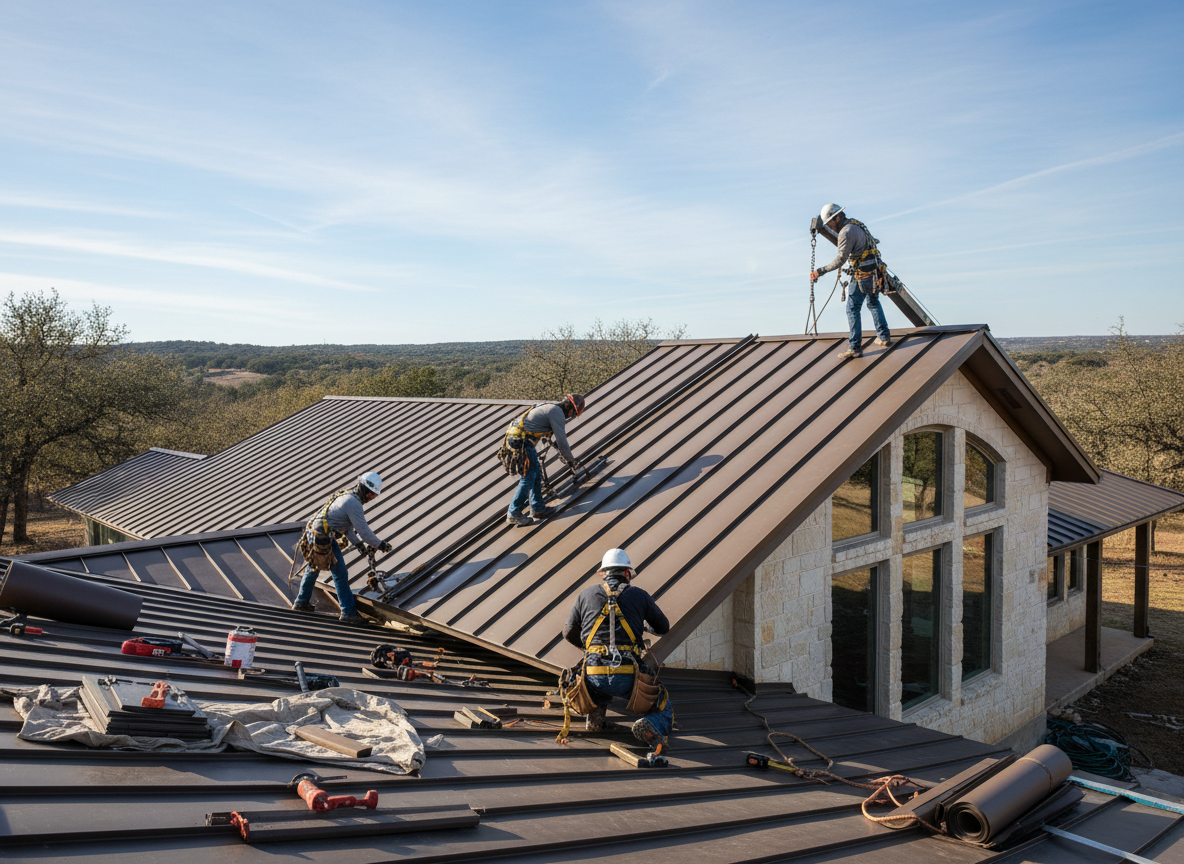
Metal roof installation in Houston is less about the panels than about what happens underneath them. Once summer humidity settles in and attic temperatures climb past 130°F, a metal roof lives or dies on its underlayment, its ventilation, and how the panels are allowed to move. Homes in the Heights, Montrose, and River Oaks often sit on older framing with 1x6 skip sheathing rather than a solid deck, and that changes the entire install sequence — you either add a solid substrate or you use a high-temp synthetic over the skip boards and detail every seam. Get that part wrong and the panels will look fine for two summers before the first ceiling stain shows up over a hallway in Midtown.
The two systems we install most across Harris County are standing seam and exposed fastener. Standing seam uses concealed clips and a mechanically seamed rib, so there are no fastener heads exposed to Gulf rain and UV — the panels float as the metal expands and contracts through a Houston day. Exposed fastener panels cost less and go down faster, which is why they dominate barns, shops, and budget-conscious re-roofs out toward Katy, Sugar Land, and Pearland. Both work here; they just fail differently. Exposed fastener roofs fail at the washer. Standing seam roofs fail at the flashing and at the clip if the deck wasn't flat.
Metal is genuinely well suited to this climate. It sheds the heavy, wind-driven rain that comes with a tropical system, it doesn't grow algae the way asphalt does in Houston's humidity, and it handles the hail that rolls through the Katy and Sugar Land corridors in spring. What it does not do is forgive a bad install. Thermal movement is real — a 40-foot panel can move a measurable amount between a cool morning and a hot afternoon — so panels need room at the eaves, the right clip spacing, and penetrations that are flashed to move with the roof, not pinned against it.
When we quote a metal roof, we're usually comparing it against a third or fourth asphalt replacement over the life of the house. That math only holds if the substrate, underlayment, and flashing are done to metal standards rather than shingle standards. It also depends on your municipality: roofing permits and inspection requirements vary between the City of Houston and the surrounding cities, and some historic districts and deed-restricted neighborhoods have their own review. Confirm what applies to your specific address before panels are ordered, because a color or profile change late in the process is expensive.
Technician insight
In Houston, the thing that catches most people out with metal roof installation is the deck underneath. A lot of the 1940s-to-1960s bungalows in the Heights and Montrose were built with 1x6 skip sheathing and no solid deck, so a metal roof can't just be screwed down the way it would be on a newer house in Katy or Pearland. You either add a solid substrate or you use a high-temp synthetic over the boards and detail every seam — and if that step gets skipped to save money, the panels look great for two summers and then you're chasing leaks. The second gotcha is attic ventilation: metal sheds heat differently than asphalt, and a roof with poor intake will cook the underlayment from below.
Standing Seam Over Skip Sheathing on a Heights Bungalow
A homeowner in the Heights was getting quotes to replace a failing asphalt roof with standing seam and kept hearing the same low number from contractors who never went into the attic. When we opened it up, the roof sat on original 1x6 skip sheathing with visible gaps and a couple of sagging rafters near the rear addition. We sistered the soft framing, added a solid substrate over the skip boards, installed high-temp underlayment, then set standing seam panels with clips sized for the thermal movement a Houston roof sees. The homeowner got the metal roof they wanted without the panels telegraphing every gap in the old deck.
Metal Roof Installation Services We Offer
✓Standing Seam Metal Roof Installation
Concealed-clip standing seam panels installed over a solid deck or high-temp underlayment, with seamed ribs and no exposed fasteners. The right choice where appearance, longevity, and low maintenance matter most.
✓Exposed Fastener Metal Panel Roofing
Screw-down through-fastened panels for homes, shops, and outbuildings where budget and speed matter more than a seamless look. Washers and fastener placement are the whole ballgame in Houston's UV and rain.
✓Metal Roof-Over-Shingle Retrofit
Installing metal panels over an existing shingle roof using battens or a recovery system, avoiding a full tear-off. Only appropriate when the deck, framing, and existing layers can be verified as sound.
✓Metal Roof Hail and Wind Damage Repair
Panel replacement, re-securing, and dent or crease assessment after hail or high wind. Cosmetic dents and structural panel damage are different problems and get different answers.
✓Metal Roof Flashing and Penetration Rebuild
Rebuilding valleys, chimneys, vents, and pipe boots so they move with the metal instead of fighting it. Most metal roof leaks in Houston trace back to flashing, not panels.
✓Metal Roof Panel Replacement and Re-Securing
Swapping individual panels, replacing failed fasteners and washers, and correcting lifted or backed-out screws on older exposed fastener roofs.
✓Metal Roof Coating and Repainting
Cleaning, priming, and recoating faded or chalked metal to extend service life. A coating is maintenance, not a fix for rust-through, loose panels, or failed flashing.
How it works
- 1
Roof Assessment and Panel Selection
We measure the roof, check the deck and framing from the attic where accessible, and look at how the existing roof is ventilated. Then we talk through panel profile, gauge, finish, and color against your home's pitch, your neighborhood's rules, and how the roof will actually perform in Houston heat and rain.
- 2
Permits, Substrate and Underlayment Prep
Roofing permits and inspection requirements vary by municipality, so we confirm what your city or district requires before work starts. On the roof, we tear off or prepare the existing surface, correct soft or uneven decking, and install the underlayment and any battens or substrate the panel system calls for.
- 3
Panel Installation and Fastening
Panels are laid out to keep seams off valleys and out of sightlines, then fastened with the clip or fastener pattern the manufacturer specifies. Thermal movement is planned for at the eaves, ridges, and every penetration so the metal has somewhere to go when it expands.
- 4
Flashing, Ventilation and Final Walkthrough
We finish valleys, ridges, sidewalls, and penetrations, then confirm attic intake and exhaust are balanced so the metal isn't trapping heat. We walk the roof and the ground with you, show the details, and leave the site clean of screws, clippings, and old roofing debris.
Pricing
Metal roof installation pricing in the Houston area is driven by square footage and roof complexity first, then by panel type, gauge, and finish. Standing seam with concealed clips costs more than exposed fastener panels because of the seaming, the clips, and the tighter tolerances. A steep pitch, multiple valleys, dormers, or a chimney adds labor and flashing time. If the existing deck is soft or the home has skip sheathing instead of a solid deck, adding substrate is a real line item. Tear-off versus a retrofit over existing shingles changes disposal and labor. Local permit and inspection fees vary by municipality and are usually separate.