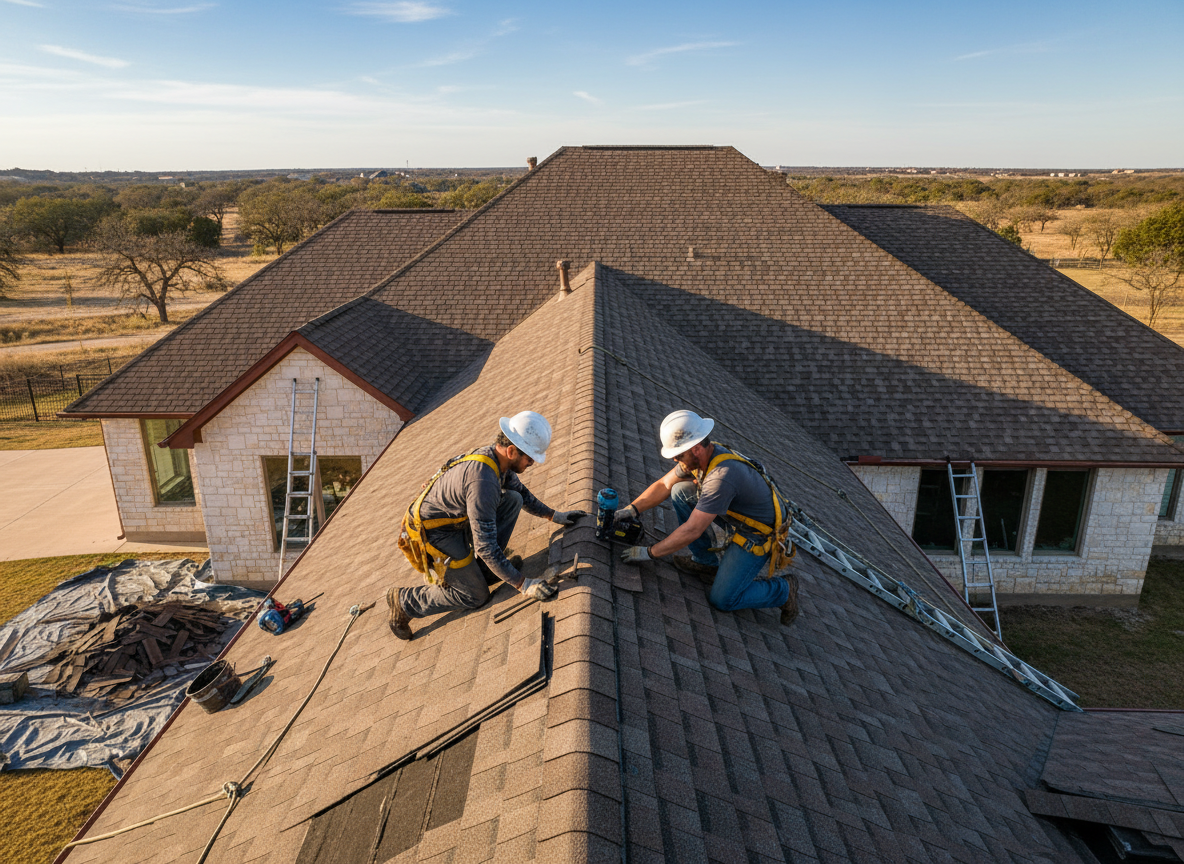
A shingle roof repair in Houston rarely starts out looking like a shingle problem. It starts as a brown ring on a hallway ceiling in a Montrose bungalow, a trail of granules in the gutter of a Heights four-square, or a flap of tab lifted over the ridge of a River Oaks home after a spring supercell. Asphalt shingles are the dominant covering across Harris County and the surrounding suburbs — from the steeper older homes near the Museum of Fine Arts and Downtown out to the newer subdivisions in Katy, Sugar Land and Pearland — and they hold up reasonably well here, provided the details around them hold up too. This service covers the repair side of that equation: locating the actual point of failure, correcting it, and closing the roof back against a climate that throws heat, humidity, wind-driven rain and hail at it in the same calendar year.
The failure modes here are specific. Sustained summer heat — long stretches in the upper 90s with humidity to match — cooks the adhesive strip on the back of each shingle and makes the mat brittle, so a shingle that would flex in a cooler market cracks instead. Thermal cycling between a hot deck and an afternoon thunderstorm works nail heads and pipe boots loose. Add the hail that tracks across the region most springs, and you get the pattern we see most often: largely intact fields of shingles with localized bruising, fractured tabs and sealant that has let go, letting water travel sideways under the course above before it ever shows up indoors. Locating the entry point rather than the stain is the whole job.
Repair is the right call more often than homeowners expect. A three-tab or architectural shingle roof that is sound across the field but has a torn valley, a failed pipe boot, displaced ridge caps or hail damage concentrated on one slope can usually be brought back to watertight without replacing the entire covering — particularly when matching material is still available. Replacement becomes the better answer when damage is spread across multiple slopes and planes, when granule loss is severe and the shingles are past their service life, when the decking or underlayment beneath is saturated, or when a second layer already sits over the first and another patch would bury a problem rather than fix it.
Anyone quoting shingle roof repair in Houston should be able to show you the failure — from the roof itself, or from photos taken up there — and explain why it happened before the conversation turns to price. Ask how the work will be detailed: a proper repair resets flashing, replaces torn underlayment and uses new shingle material rather than relying on sealant alone. Permits vary by municipality, and the City of Houston, Katy, Sugar Land and Pearland each handle roofing work differently, so confirm what your jurisdiction requires for the scope being proposed, especially if a partial or full replacement enters the picture. Texas Roof Specialists is a statewide service-connection brand, and we hold RCAT certification.
Symptoms That Point to Shingle Damage
Water almost never enters where it exits, so the visible symptom is usually a late clue. Watch for:
- Ceiling or wall stains that reappear or grow after heavy rain, especially near chimneys, vents and exterior walls.
- Granule accumulation in gutters and at downspout outlets — a steady trail means the shingle surface is aging or has been bruised.
- Lifted, curled or missing tabs, most often on south- and west-facing slopes that take the worst of the afternoon sun.
- Cracked or dry-rotted pipe boots and the rubber collars around plumbing vents.
- Displaced or missing ridge caps after a wind event, which open the highest and most exposed part of the roof.
- Daylight visible through the roof deck from inside the attic, or dark staining on rafters and sheathing.
- Damp or matted insulation in the attic, which often points to a slow leak that has been running for weeks.
- Ponding or overflow at valleys, where debris collects and water backs up under the courses above.
Shingle Systems and Materials We Work With
Most Houston-area homes carry one of three asphalt shingle types, and the repair approach differs for each.
Three-tab shingles are the older, thinner standard still common on mid-century homes in the Heights, Montrose and older parts of Pearland. They tear and lift more readily under wind, and matching them is increasingly difficult as manufacturers retire colors. A torn three-tab field can often be repaired, but repeated patching on a brittle 20-year-old three-tab roof usually signals replacement.
Architectural (dimensional) shingles are the current default on most homes built or re-roofed in the last 25 years, including the bulk of Katy and Sugar Land subdivisions. They are heavier, handle wind better and tolerate localized repair well when material is available.
Impact-rated shingles are increasingly specified in hail-prone parts of the state. They resist bruising better than standard products, but they still fail at flashings, pipe boots and sealants. No shingle type replaces correct detailing at the penetrations.
Repairs also involve the components around the shingle field: synthetic underlayment at valleys and eaves, new ridge and hip cap shingles, step and counter-flashing at masonry, and metal drip edge at rakes and eaves. Where a repair sits at a valley or a wall intersection, underlayment matters more than the shingle above it.
How a Roof Inspection Actually Works in This Climate
A useful inspection here is not a walk around the driveway. It starts on the roof, moves into the attic, and cross-references what the homeowner is seeing inside.
On the roof, the crew checks the field for bruising, fractured tabs and granule loss, then works the details in order of how often they fail: pipe boots, chimney and wall flashing, valleys, ridge and hip caps, then fasteners and exposed nail heads. South and west planes get closer attention — that is where UV exposure is heaviest and sealant breaks down first. Attic access is often the deciding step. A stain on a ceiling does not tell you the entry point; water tracking along a truss or a top plate does. Damp decking, rusted fasteners or stained sheathing narrows the search quickly.
After storm events, the pattern is usually concentrated rather than uniform — one slope, one ridge line, or the windward face of the house. That concentration is the difference between a repair and a replacement conversation.
Repair or Replace? What Decides It
Several factors point toward repair, and several point the other way. Repair is generally appropriate when:
- Damage is limited to one or two slopes, or to discrete components like flashing, boots or ridge caps.
- The surrounding shingles are pliable, still have surface granules, and lie flat.
- The roof deck is dry and sound, and the underlayment has not failed broadly.
- Matching or reasonably close shingle material is available for the repair area.
- There is a single layer of shingles on the roof.
Replacement tends to make more sense when damage is scattered across multiple planes, when granule loss is advanced across the field, when the attic shows widespread damp decking or staining, when the roof already carries two layers, or when a patch would sit inside a field of shingles that are themselves near the end of service. Age matters, but it is not the only test — a well-detailed 15-year-old roof can be repaired, and a poorly detailed 10-year-old roof sometimes cannot.
Where a homeowner is weighing roof repair against roof replacement, the honest answer is often decided by how much of the watertight system — not just the shingles — is still intact.
Houston Weather and What It Does to a Shingle Roof
The local climate is subtropical: hot, humid summers and mild, short winters, with the Gulf feeding moisture into almost every system that crosses the region. That combination drives three distinct pressure points.
Heat and UV. Prolonged high temperatures soften the adhesive that bonds each course to the one below. Once that seal releases, wind gets underneath. The mat itself also dries out, so shingles that would flex elsewhere snap instead.
Wind and hail. Spring and early summer storms bring hail that bruises shingle mat and knocks granules loose, sometimes without punching a visible hole. Straight-line winds lift tabs and peel ridge caps, and tropical systems bring longer-duration wind that works fasteners loose across the whole field.
Heavy rain. Harris County can receive enormous rainfall in short windows. When a roof is already compromised at a flashing or a boot, that volume finds it fast. Water backs up at valleys, runs sideways under lifted courses and shows up far from the actual opening.
Winter matters less here, but a hard freeze still affects sealants and any plumbing or HVAC penetrations that have already started to fail.
What Shingle Roof Repair Costs Depend On
Repair pricing is driven by scope and access, not by a flat rate. The main variables are:
- Extent of damage — a single pipe boot sits at one end of the range; a torn valley with saturated decking sits at the other.
- Roof pitch and height, and how many stories the crew is working from.
- Access, including whether equipment can reach the affected slope or whether material has to be carried and staged manually.
- Decking condition — any rotted or delaminated sheathing that has to come out and be replaced.
- Material matching — discontinued colors and profiles can require a wider repair area to blend acceptably, or a partial re-cover of one plane.
- Layered roofs, where existing shingle layers must be cut back to reach the deck.
- Permit requirements, which vary by municipality and can add both cost and time.
- Attic or interior access work needed to confirm the leak source before anything is opened up.
A quote that does not itemize these is hard to compare against another. Ask what is included, what is excluded, and what happens if the decking turns out worse than expected once the repair area is opened.
What to Discuss With Your Contractor Before Work Starts
Walk through these points before anyone gets on the roof:
- How the failure was identified. Ask to see roof-level photos or the actual material, and have the contractor explain the mechanism, not just the location.
- The repair scope in writing — how many shingles, which flashings, whether underlayment is being replaced, and how the area will be tied back into the surrounding courses.
- Material matching. Which shingle product is being used, and what it will look like next to the existing field.
- Decking contingency. What the contractor will do if sheathing under the repair is soft or delaminated, and how that changes the price.
- Permits. Confirm which municipality has jurisdiction and whether the proposed scope requires a permit; Houston, Katy, Sugar Land and Pearland do not all treat roofing work the same way.
- Attic and interior protection. How ceilings, furniture and landscaping will be protected, and how debris will be removed — including a magnetic sweep for nails.
- What is not being repaired. A good contractor will tell you which areas are marginal and worth watching, rather than implying the whole roof is now new.
- Documentation. What you will receive afterward: photos, a description of work performed, and any material information for future repairs.
Technician insight
In Houston, the thing that catches most people out with Shingle Roof Repair is that the leak they can see is almost never above the stain — in the older bungalows around the Heights and Montrose, water often enters at a cracked pipe boot or a step flashing and runs twenty feet along a truss before it drips through a ceiling. The second surprise is the roof itself: many of these houses were originally decked with spaced plank sheathing, so a repair that opens up more than a small area often needs new underlayment and decking work that nobody budgeted for. Ask about deck condition before the price is fixed.
Ridge Caps and a Chimney That Wasn't the Problem
A homeowner in the Heights kept getting a damp patch on a back bedroom ceiling after heavy rain, and two previous visits had re-sealed the chimney flashing without stopping it. A rain-day attic inspection showed water tracking along a truss and dripping several feet from the chimney, with the actual entry point at a cracked pipe boot on the slope above. We replaced the boot, reset the surrounding shingles and underlayment, and re-sealed the ridge caps that had lifted on the same plane. The ceiling stayed dry through the following storm cycle.
Shingle Roof Repair Services We Offer
✓Storm and Hail Shingle Repair
Repair of bruised, fractured or granule-stripped shingles after hail or high wind, usually concentrated on one or two slopes. Includes checking whether the damage is isolated or spread across multiple planes.
✓Roof Leak Detection and Repair
Tracing an interior stain back to its actual entry point at a flashing, boot, valley or lifted course, then correcting it. Water frequently enters well above or beside where it shows up indoors.
✓Missing and Wind-Lifted Shingle Replacement
Replacing tabs that have torn free or released their seal on exposed south and west slopes, and re-sealing the surrounding courses so wind cannot get back underneath.
✓Ridge Cap and Hip Shingle Repair
Reset or replacement of the shingles along the highest, most wind-exposed lines of the roof, where caps commonly lift and separate after storms.
✓Flashing and Pipe Boot Repair
Correcting step flashing at walls and chimneys, counter-flashing at masonry, and the rubber collars around plumbing vents, which crack and dry out faster than the shingle field around them.
✓Valley and Penetration Repair
Repair at roof valleys and around vents, HVAC curbs and exhaust penetrations, where debris collects, water backs up and underlayment condition matters as much as the shingles above it.
✓Roof Deck and Underlayment Repair
Replacement of soft or delaminated sheathing and failed underlayment uncovered during a repair, so new shingles are fastened to a sound surface.
How it works
- 1
Roof-Level and Attic Inspection
We get on the roof to assess the field, flashings, penetrations, valleys and ridge lines, then check the attic where accessible to see how water is actually tracking. The goal is to identify the entry point, not just the stain.
- 2
Findings and Repair Scope
You get a plain explanation of what failed and why, along with the repair scope: which shingles, which flashings, whether underlayment or decking is involved, and whether repair or replacement is the more sensible path. Permit requirements for your municipality are confirmed at this stage.
- 3
Material Matching and Preparation
We identify shingle material that matches or blends acceptably with the existing field, protect landscaping and interior surfaces, and stage material for the affected area.
- 4
Repair and Detailing
Damaged shingles are removed, failed underlayment and soft decking are replaced as needed, flashing and boots are reset or renewed, and new shingles are tied back into the surrounding courses so the repair sheds water the way the original roof was meant to.
- 5
Cleanup and Walkthrough
The work area is cleared, nails are swept with a magnet, and we walk the repair with you — what was corrected, what to watch, and what documentation you are receiving.
Pricing
Repair pricing depends on the extent of damage, roof pitch and access, decking condition, material matching, whether the roof already carries a second layer, and any permit requirements your municipality imposes. Quotes should be itemized rather than quoted as a single lump figure.