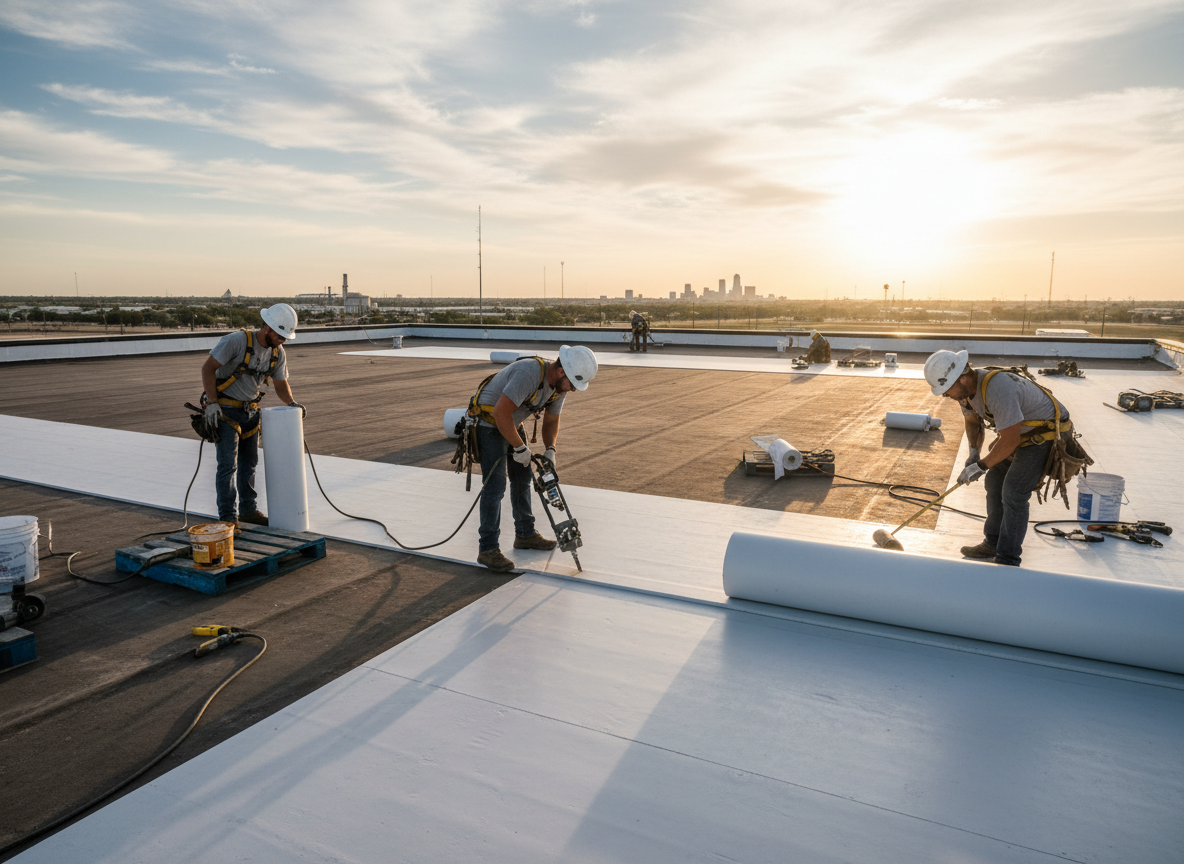
Temple sits right where Central Texas weather does its worst work on roofs. Summers bake shingles for months, then spring thunderstorms roll up the I-35 corridor with wind-driven rain and hail that pocks asphalt, cracks seals around vents and pipe boots, and drives water past flashing that was fine in April. Winter is mild, but the freeze-thaw swings between a warm afternoon and a cold night still work nails loose and open seams. By the time a stain shows up on a ceiling near Downtown Temple or along TX-36, the leak has usually been running for a while.
The housing stock here is a mix, and it matters. Older homes around Downtown Temple and the established blocks of North Temple and South Temple often carry original plank decking, multiple re-roof layers and aging chimney or valley flashing — repairs there are about matching what is already on the roof rather than selling a whole new system. Newer construction in West Temple and Hickory Hollow tends to fail differently: ridge and valley details, improperly sealed penetrations, and shingles that have taken a decade of Texas sun. Roof replacement decisions in Temple usually come down to how many repair cycles a roof has left versus how much decking and flashing will need replacing anyway.
Texas Roof Specialists is a statewide roofing service-connection brand, with our supplied business address in Houston, connecting Temple homeowners and property managers with roofing contractors for repair, replacement, installation, inspections and ongoing maintenance. We hold RCAT certification, and we talk plainly about scope: what is a repair, what is a replacement, and what your insurance carrier will actually need if hail or wind is involved. Whether you are near Baylor Scott & White Medical Center, off US-190, or in a neighborhood off I-35, the goal is the same — a clear, itemized scope and workmanship you can walk out and inspect.
Roofing Services Commonly Needed in Temple
Temple roofs rarely need just one thing. The work we connect homeowners with covers the full range: roof repair for active leaks, missing shingles, failed flashing and storm damage; roof replacement when a system is past its service life or has been written off after hail; new roof installation and re-roofs on homes and light commercial buildings; roof inspections for buyers, sellers and insurance documentation; and scheduled maintenance that clears debris, reseals penetrations and catches small failures before they soak insulation. Material-wise, Temple roofs are mostly asphalt shingle, with metal and tile systems on a meaningful share of homes, and each behaves differently under hail and heat — which is why the estimate should name the system, not just the square footage.
Storm, Hail and Heat: What Temple Roofs Face
Spring thunderstorms in Bell County are the headline risk. Hail bruises shingle mats and knocks granules loose, which shortens life even when nothing looks torn; wind lifts ridge caps and peels tabs along gable ends and open exposures. Summer heat then accelerates the damage — softened asphalt, dried-out sealant, and thermal expansion that widens every gap hail created. After a storm, the useful sequence is inspection first, documentation second, and repair or replacement third. If you are filing a claim, photographs, measurements and a written scope carry far more weight than a verbal opinion, and a contractor who documents the roof properly makes that process easier.
Permits, Access and Scheduling in Temple
Around Temple
We regularly work near:
- 📍Temple Railroad and Heritage Museum
- 📍Miller Park
- 📍Baylor Scott & White Medical Center
- 📍Downtown Temple
Roof Repair in Temple — Local Notes
- •Housing stock in Temple splits roughly in two: older homes around Downtown Temple, North Temple and South Temple with plank decking, layered shingles and aging flashing, versus newer builds in West Temple and Hickory Hollow where the common failures are penetration seals, valleys and sun-aged shingles. Repair scope should be written for the roof you actually have.
- •Hail and wind-driven rain from spring thunderstorms are the dominant loss drivers in Bell County, and hail damage often shows as granule loss and bruised mat rather than obvious holes. Inspections after a storm should document both, since carriers weigh photographic evidence heavily.
- •Access and staging vary block to block. Narrow streets and mature trees in the older neighborhoods slow material delivery, while steep two-story pitches and long runs on newer homes change labor time. Permits and inspection requirements in Temple are jurisdiction-dependent — verify them for your specific address and scope.
Nearby cities we serve